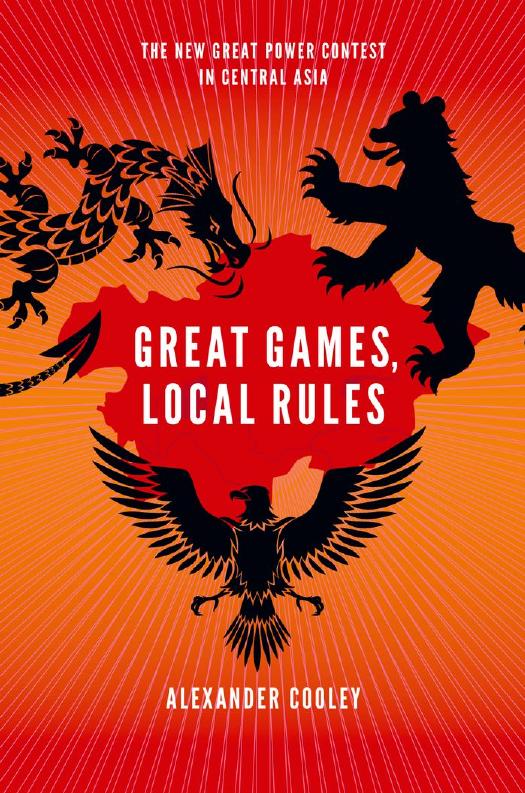
Great Games, Local Rules: The New Great Power Contest in Central Asia by Alexander Cooley
Author:Alexander Cooley
Language: eng
Format: mobi, pdf
Publisher: Oxford University Press
Published: 2012-06-22T06:00:00+00:00
8
The Price of Access: Contracts and Corruption
Central Asia continues to face severe governance and corruption problems. Domestically, patronage politics and informal networks channel unofficial economic activity, while the use of state resources for personal profit by elites remains a “local rule” throughout the region. Corruption is so pervasive within Central Asian state institutions that some have referred to it as a sanctioned and prevalent informal tool of administrative control, allowing rulers to blackmail and effectively sanction subordinates who fall out of line.1 Moreover, the types of external revenues that have flowed from the international economy and community into the Central Asian countries—security assistance, international aid, rents from the sale of natural resources—are also among the types of revenues most susceptible to graft, misappropriation, and corruption on the part of ruling regimes.2
The magnitude of the problem warrants some quick comparisons. Over the last decade, international anti-corruption watchdogs, such as Transparency International and Global Integrity, have consistently ranked the Central Asian countries at the bottom of their global indices. Figure 8.1 presents a time-series of the World Bank’s indicators on “control of corruption,” a bundle of available corruption surveys. The Central Asian states rank in the bottom 10 percentile in the world, with the exception of Kazakhstan, which, in recent years, has improved modestly to rank in the bottom 20 percentile.
Figure 8.2 shows how unfavorably Central Asia compares even to the Middle Eastern states that experienced the so-called Arab Spring. Even though public discontent about corruption and accountability were important drivers of the 2010 anti-government protests in Tunisia, Egypt, and Jordan, these countries still rank considerably higher than their Central Asian counterparts, with only Libya and Syria recently dipping below the 20-percentile mark. Interestingly, Djibouti, which hosts the largest U.S. military base in Africa, scores considerably better than its Central Asian–base hosting counterpart, Kyrgyzstan.
Download
Great Games, Local Rules: The New Great Power Contest in Central Asia by Alexander Cooley.pdf
This site does not store any files on its server. We only index and link to content provided by other sites. Please contact the content providers to delete copyright contents if any and email us, we'll remove relevant links or contents immediately.
| Anthropology | Archaeology |
| Philosophy | Politics & Government |
| Social Sciences | Sociology |
| Women's Studies |
The Secret History by Donna Tartt(19294)
The Social Justice Warrior Handbook by Lisa De Pasquale(12224)
Thirteen Reasons Why by Jay Asher(8996)
This Is How You Lose Her by Junot Diaz(6955)
Weapons of Math Destruction by Cathy O'Neil(6363)
Zero to One by Peter Thiel(5864)
Beartown by Fredrik Backman(5839)
The Myth of the Strong Leader by Archie Brown(5552)
The Fire Next Time by James Baldwin(5503)
How Democracies Die by Steven Levitsky & Daniel Ziblatt(5271)
Promise Me, Dad by Joe Biden(5189)
Stone's Rules by Roger Stone(5130)
A Higher Loyalty: Truth, Lies, and Leadership by James Comey(5017)
100 Deadly Skills by Clint Emerson(4972)
Rise and Kill First by Ronen Bergman(4838)
Secrecy World by Jake Bernstein(4798)
The David Icke Guide to the Global Conspiracy (and how to end it) by David Icke(4771)
The Farm by Tom Rob Smith(4550)
The Doomsday Machine by Daniel Ellsberg(4545)
